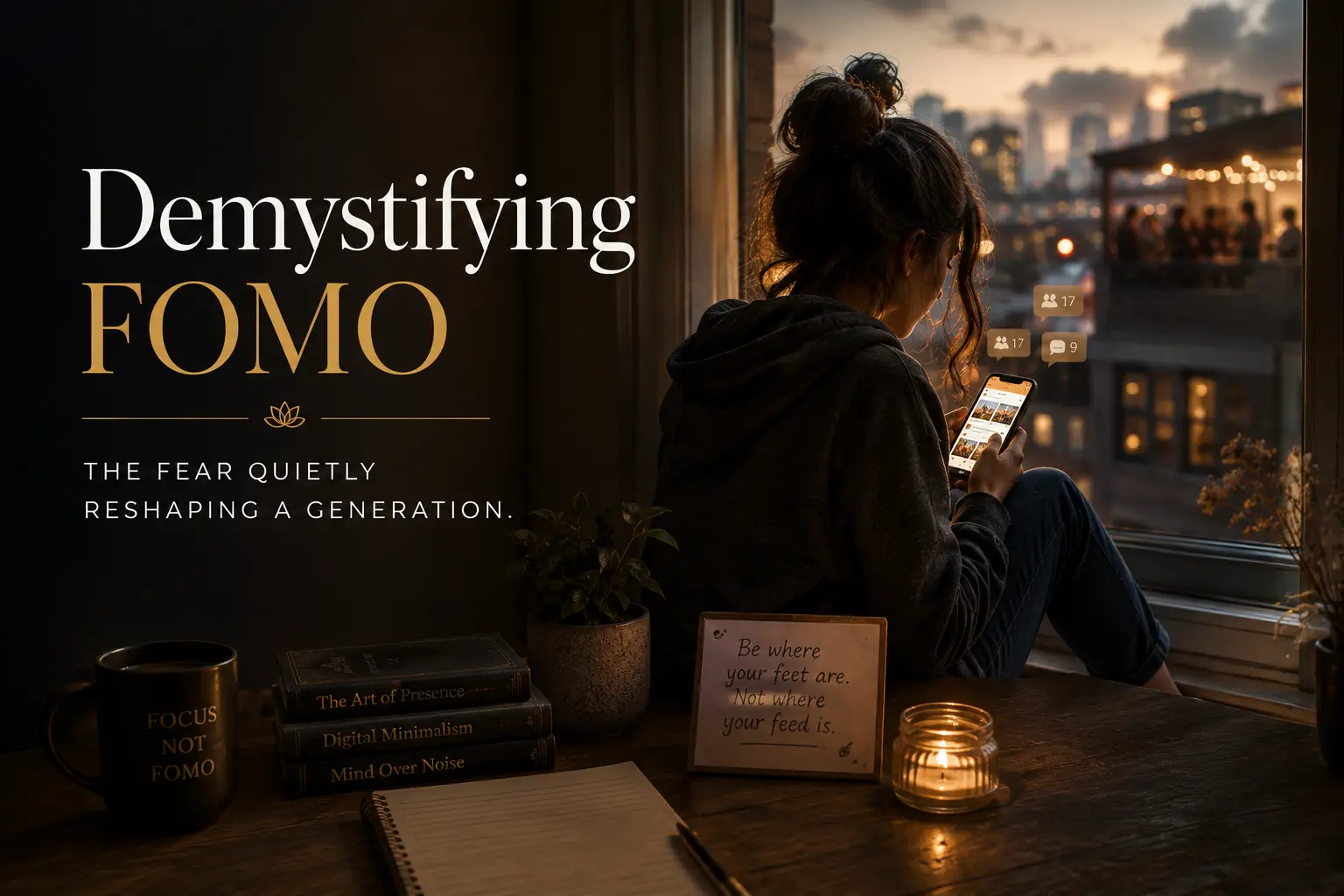
'FOMO' arrived in my vocabulary courtesy of Gen Z — and, as it turns out, I've been learning more than just the word. I've been learning the thought behind it: compressed, abbreviated, hidden in plain sight, waiting for the light of day to be properly understood. It's one of those words that slips quietly into a conversation, earns a polite nod, and then, given a moment, unfolds into something far larger and more consequential than its four letters let on.
Fear Of Missing Out. Simple enough on the surface. Profound — and more than a little unsettling — once you look closer.
Every generation carries its own defining anxiety. For those who came before Gen Z, it was peer pressure — that quiet, relentless compulsion to excel academically, professionally, socially. To be seen keeping up. To not fall behind. That pressure wore a blazer. It sat in classrooms. It whispered across dinner tables. FOMO wears a ring light.
In this era of digital transformation — interestingly also called the Information Age, though that label grows more questionable by the day — peer pressure hasn't vanished. It has simply reinvented itself with algorithmic precision. Fear of missing out now drives young minds toward whatever promises instant limelight, instant gratification. The currency has shifted, too — from quiet approval to visible, quantifiable validation: likes, views, shares, followers. The anxiety is the same one it always was. Only the stage has grown exponentially larger. What peer pressure once whispered, FOMO now broadcasts — and the audience is no longer the classroom or the neighbourhood. It is the world, available at thumb's reach, twenty-four hours a day.
The Quiet Remodel
Somewhere in the middle of this transformation, 'content' remodelled itself into 'content creation.' It sounds like progress. In many ways, it genuinely is. But it's worth pausing to consider what else shifted quietly in that same transformation. In a digital landscape with no real regulation and no real referee, the boundaries of discretion, credibility, authenticity, and creativity are being redrawn in real time, without a rulebook — and often without anyone watching to see where the lines used to be.
None of this negates what's genuinely worth celebrating. The democratisation of expression is extraordinary. Every voice now has a potential platform. Every story, a potential audience. That is not nothing. That is, in fact, everything free expression has ever aspired to be.
And yet. FOMO also opened the floodgates on an explosive sharing of the everyday — the kind of thing an earlier era would have quietly left private, personal, unremarkable. Breakfast became a flat lay. A walk became a reel. A difficult emotion became a trending audio clip. The impulse behind it wasn't always vanity. More often, it was something more anxious and more human: the quiet fear that a life unlived publicly somehow counted for less.
In FOMO's Defence
Intellectual honesty demands a pause here, because FOMO is not entirely the villain of this story.
Many of its consequences were genuinely encouraging. Colleagues and friends, caught in the tide of pandemic-era restlessness, picked up hobbies with a new and visible enthusiasm. Reading returned. Literary work found new audiences. Art, gardening, trekking, camping, fitness — all of it took on a more glamorous, more shareable look, and in doing so, became more accessible, more aspirational, more communal. People who had never thought of themselves as creative began creating. People who had once exercised in private began inspiring others to move.
FOMO, in this iteration, functioned almost as an accidental public health nudge — ungoverned, unplanned, but occasionally effective. The fear of being left behind became, for a while, the motivation to join in. And what people joined in with was not always trivial. Credit where it's due.
Where the Calculus Turns
But FOMO also lent momentum to something less wholesome — a push into uncharted, occasionally uninhibited, and unexpurgated territory. This is where the arithmetic gets complicated.
That particular collision — the thrill of unanticipated visibility meeting the heady rush of sudden attention — has, more than once, tossed common sense, maturity, and discretion out with the bathwater. What begins as the simple joy of being seen can curdle, almost imperceptibly, into the compulsion to keep being seen — at any cost, by any means. Boundaries that once served as natural governors — of taste, of privacy, of consequence — start to feel less like sense and more like obstacles standing between a person and relevance.
Money complicates it further. The knowledge that attention converts to income, that virality carries a price tag, has pushed a growing number of digital creators to work the process backwards. The question stops being what do I want to say? and becomes, instead, what will perform? What that inversion has done to the wider culture is, as they say, there for all to see — in comment sections, in trending tabs, and in the slow, steady erosion of what still passes for discourse.
What Happened to Humour
No honest account of FOMO can skip what it has done to one of our oldest and most reliable social lubricants: humour.
There was once a genre — call it 'Humour in Uniform' — built on subtlety, quick wit, and discernment. The kind of joke that rewarded a little attention and a little intelligence. The kind that landed softly, and then stayed. FOMO, with its appetite for immediacy and maximum reach, has nudged comedy somewhere louder — toward the flamboyant, the reactive, the slap-in-the-face.
Nuance is slow. And nuance, by definition, does not trend. A well-built observation takes longer to land than a reaction video, and in the economy of digital attention, slowness has become a liability. Talk shows have edged out discussion. Catchy one-liners have edged out considered argument. Somewhere along the way, the performance of an opinion became more valuable than the forming of one.
The Cost to Thought
Perhaps the most sobering thing FOMO is doing — quietly, incrementally — is to the quality of thought itself. It drags intelligence into jumping the gun. The impulse now is to react before reflecting, to post before processing, to perform before understanding.
Into that widening vacuum of deliberate thought, artificial intelligence has arrived — not as a villain, but as an extraordinarily convenient solution to a problem we helped create ourselves. We've delegated the brainstorming to neural networks. We were clever enough, after all, to teach machines how to compute, design, draw — even to think and act in a passable simulation of human cognition.
The machines are learning. And we, perhaps, are in the early stages of a kind of cultural de-learning — laughing our way, reel by reel, toward a despondency we haven't yet found the words for. The irony writes itself: we built intelligence into our machines at almost exactly the moment we began outsourcing ours to them.
The Question Worth Sitting With
Every generation eventually arrives here — at an inflection point, squinting into a future that is partly of its own making and partly beyond its control. FOMO is not the first anxiety to define a generation, and it will not be the last. But this one is distinctly ours — or rather, theirs, Gen Z's — with the rest of us watching, adapting, and occasionally borrowing their vocabulary just to keep up.
Which is, if you think about it, its own quiet form of FOMO.
The question worth sitting with — away from the notifications, away from the metrics — is this: in a world engineered to make us afraid of missing out, what are we actually missing out on while we're perpetually online?
Until we relearn a little humanity from artificial intelligence, that question may be the most important one we are not asking.
The author is a medical professional and writer whose reflections bridge clinical insight with cultural observation.