The call came at the worst possible moment, which is, I've noticed, the only moment calls like this ever come.
We had just finished the ritual hugging that precedes any proper reunion of old friends — the kind that lasts a beat too long because nobody wants to be the first to let go — and were easing into that loose, unhurried chatter that only decades of friendship can produce, when my phone lit up. My son. Calling, not texting, which in our family has always meant this matters.
"I'm driving home," he said, "after a year, and I'm bringing—"
And then, nothing. The line dropped the way lines only drop in moments of maximum consequence, as if the universe itself has a flair for cliffhangers.
I was an hour and a half from home, worn thin by a long day, and looking forward to nothing more strenuous than dinner and gossip with old friends. The last thing I wanted was a night drive. And yet there I sat, phone in hand, willing it back to life, while my imagination — unsupervised, unchaperoned, and running entirely on adrenaline — began assembling scenarios with the enthusiasm of a director who has just been handed an unlimited budget. A fiancée. A business venture. A tattoo. Possibly all three.
My friends, God bless them, refused to let the evening sour. They kept the wine flowing and the jokes coming, pausing only now and then to remind me — with the smug tenderness of people who have clearly done this before — that a mother's imagination, left to its own devices for eight hours, can conjure disasters no insurance policy on earth would cover.
They were, of course, right. By midnight, I had lived through eleven distinct catastrophes, none of which turned out to be true.
Arrival
I drove home the next morning propelled by something closer to hunger than curiosity — the specific, gnawing kind that only unanswered questions produce. And when I finally walked through my own front door, what greeted me stopped me cold.
Two enormous, liquid eyes. Staring up at me with an expression that managed, somehow, to contain hope, love, and shameless expectation all at once — the universal look of every creature that has just realized it might get fed.
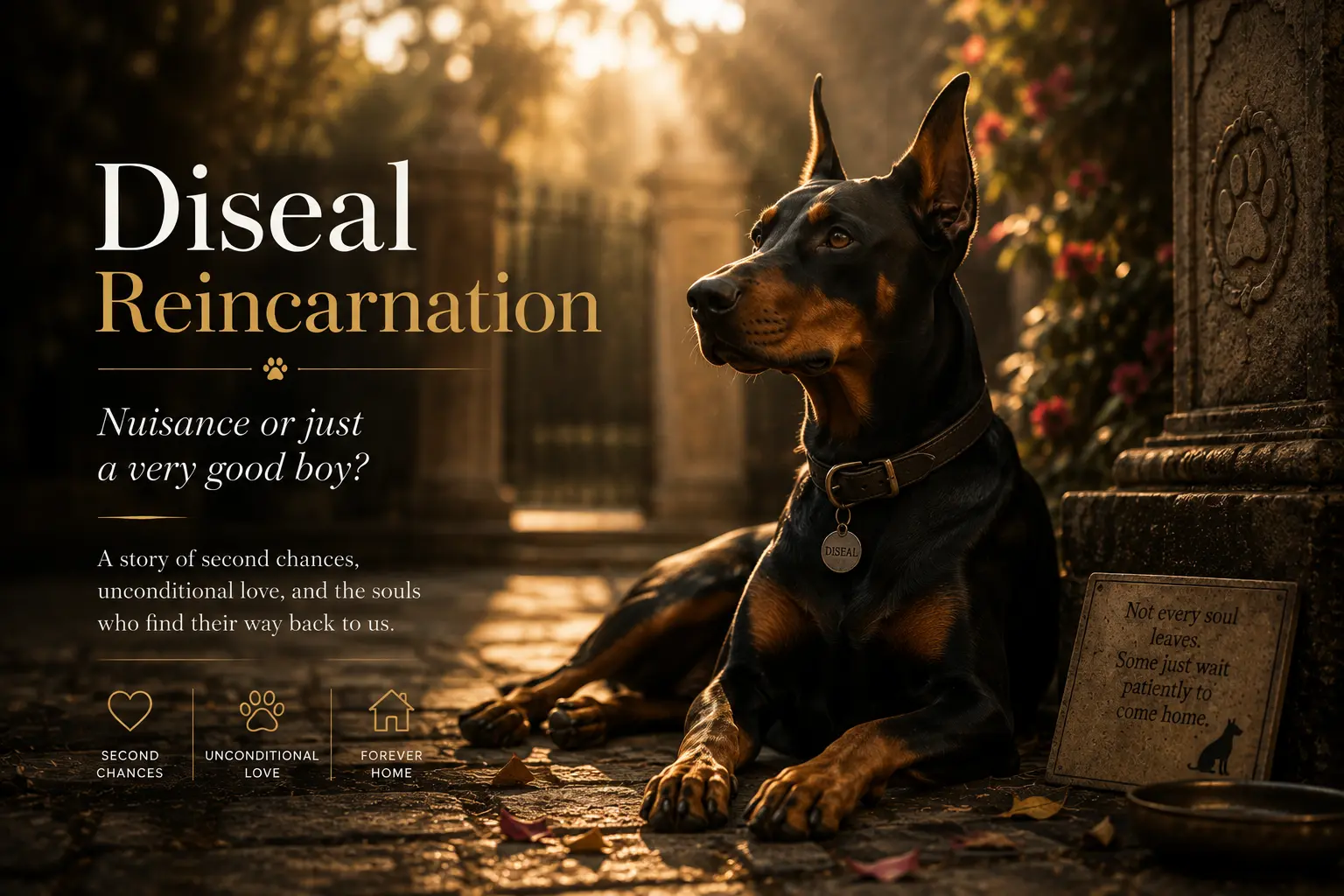
A puppy. A small, absurd, entirely disarming Doberman, if one may take such liberties with a breed not generally associated with the word cute. This — this small trembling bundle of paws and ambition — was what had pulled my son home across a year and half a country.
The love of dogs, it turns out, runs in the blood. I've always thought them more honest than most people I know — certainly more sensible than their self-congratulating, supposedly "evolved" masters. My son stayed only long enough to make sure the puppy had filed his scent and face away for future recognition, then left again, entrusting me with a name I still can't decide how to pronounce: Diseal.
What followed were two of the strangest weeks of my life — not because of the puppy, who did exactly what puppies do, but because of everyone who came to see him.
Because it turns out a puppy cannot simply be a puppy. Not in this house, not with this crowd. He would be required, depending entirely on who rang the doorbell, to also serve as a religious icon, a public menace, a health statistic, and a moral cause. Diseal, blissfully unaware of the roles being assigned to him, slept through most of his own controversy.
The Believer
The first visitor was an aunt of the old school — the kind who blesses every threshold she crosses, out of habit more than belief, though it's hard to tell where one ends and the other begins.
She took one look at Diseal and folded her hands as though standing before a shrine.
"Dogs," she announced, lowering herself onto the sofa with the gravity of scripture, "are the reincarnation of god."
She spoke of loyalty as though it were sacrament, of unconditional love as evidence of something beyond flesh and fur. Before the tea had even cooled, she'd woven in old texts, half-remembered rituals, and a gentle suggestion that Diseal's arrival deserved a small ceremony — one that would, naturally, require a proper lunch afterward.
I understood her, in a way. There is something in a dog's devotion that seems to outsize the animal carrying it. But I also recognized, not for the first time, the particular species of person who cannot simply enjoy a thing without first dragging it through ritual, and then through ego. By the time she left, a puppy's first week home had, in her retelling, acquired the weight of prophecy — complete with the quiet implication that she alone had sensed it coming.
The Complainant
Not everyone arrived to worship. A neighbor from two doors down — a man who keeps his windows shut even in the thick of the Nashik heat, as though air itself might carry an inconvenience — came only to object.
"Dogs barking," he said, before Diseal had made a single sound, "is intolerable."
It was, I had to admire, a remarkable feat of pre-emptive grievance — like reporting a crime that hasn't happened yet, to a court that hasn't convened. He spoke of sleepless nights he had not yet had, of a peace he had already decided would be shattered, with the particular certainty of a man who arrives at his conclusions well before any evidence has the chance to object.
I've encountered enough of his kind to know that no reassurance moves them. The truly uptight rarely allow themselves to be charmed — not by warmth, not by good behavior, not even by two enormous, hopeful eyes. He left unconvinced, already composing, I suspect, his first noise complaint. Diseal, for his part, returned to the business of destroying a slipper, entirely indifferent to the reputation being drafted in his absence.
The Realist
My cousin arrived next, straight from her shift at a local veterinary clinic, and brought with her a perspective no amount of tea could soften.
She spoke, as she often does, of the strays she treats — the bite wounds she stitches, the road accidents she can't always fix, the quiet menace of rabies in the places vaccination drives never quite reach. There was no cynicism in her voice, and none of my aunt's reverence either. Just the plain, unadorned weight of someone who has seen the underside of the story we were currently living the good half of.
Listening to her, I felt, more sharply than before, the sheer luck of Diseal's beginning — born into vaccinations, a vet on call, a family that had waited a year just to bring him home. Not every dog gets that. Her stories were less an argument and more a quiet reminder: that circumstance decides most of a dog's fate long before charm, or cuteness, or luck ever gets a vote.
The Activist (From a Safe Distance)
Then came a younger acquaintance, alight with passionate talk of animal rights — the cruelty of factory farming, the neglect of strays, the moral urgency of it all. She spoke with real fire, the kind that makes you sit up straighter and reach, almost involuntarily, for your wallet.
But when the conversation turned practical — had she ever fostered a dog? Volunteered at a shelter? Given money to build one? — the fire dimmed with startling speed into vague gestures, half-sentences, and a sudden, urgent need to check her phone.
It was a familiar type of conviction: loud in public, quiet in practice. I don't doubt her sincerity — I rarely do, with people like her — but sincerity without follow-through has a way of mistaking noise for movement. Rather like applauding loudly from the sidelines of a marathon you have no intention of running.
What the Mirror Showed
By the time the fortnight of visitors finally wound down, I understood what Diseal had become, without ever meaning to: a mirror. A small, furry, food-obsessed one, reflecting back exactly what each person walked in already carrying.
My aunt saw the divine. My neighbor saw disturbance. My cousin saw the fragile line between a cherished pet and an abandoned stray. My young acquaintance saw a cause — comfortably, safely, from a distance.
Diseal saw none of it.
He saw only that we were home. That there might be a game to play, a slipper to ruin, a biscuit somewhere within reach.
Perhaps that's the real lesson dogs keep trying, patiently, to teach their supposedly evolved masters — that so much of what we bring to them is really about us, and so very little of it, in the end, is about them at all.